


WHEN FAITH MEETS ENGINEERING: HOW JEF BUILT THE WORLD'S FIRST 200kA LIGHTNING PROTECTION SYSTEM FOR AYODHYA'S RAM MANDIR
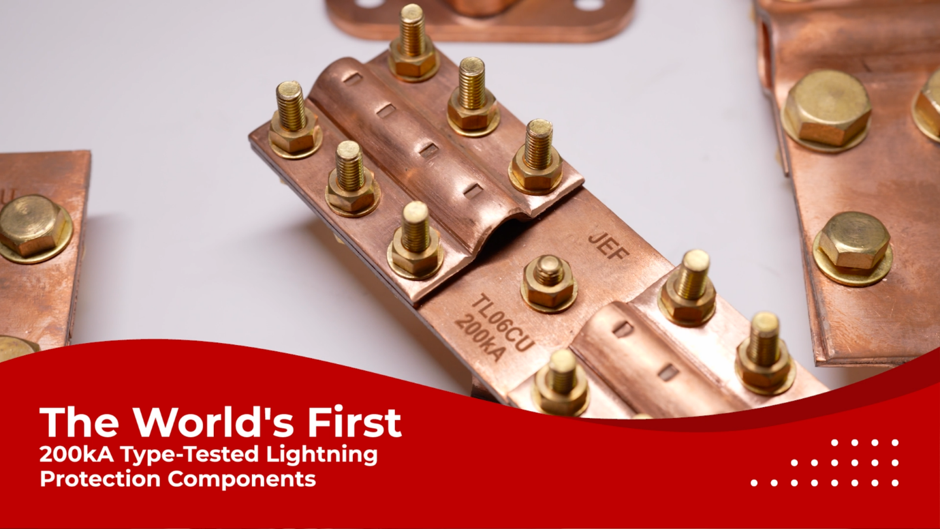
The Shree Ram Janmabhoomi Temple in Ayodhya is not just a place of worship — it is a landmark of national pride, built to stand for centuries. When the temple trust began planning its infrastructure, they made an extraordinary demand: the lightning protection system had to be twice as powerful as anything the global standards required.
That challenge landed on JEF's desk. What followed was a first in the history of lightning protection engineering worldwide.
Why Lightning Protection at This Scale?
Lightning protection systems are rated by the magnitude of impulse current they can safely conduct. The international benchmark, as defined by IEC 62305, is 100kA — the standard that governs protection design for critical structures across the world.
The Ram Mandir Trust wanted more. Their mandate: protect the temple at 200kA, an energy level four times higher than what any commercially available lightning protection or earthing product in the world was designed to handle.
This wasn't an incremental upgrade. It was a leap into entirely uncharted engineering territory.
The Challenge: No Product in the World Qualified
When JEF's team assessed the requirement, a hard truth emerged — no manufacturer anywhere had a complete, type-tested range of components rated for 200kA lightning impulse current. Not in Europe. Not in the United States. Not in Asia.
Type-testing is not a formality. It means subjecting every component — air terminals, down conductors, earthing electrodes, connectors — to internationally accredited laboratory testing at the exact impulse current rating they will be expected to handle in the field.
A system is only as strong as its weakest link, and every link had to be tested.
JEF had two options: source components that didn't exist or build them.
They chose to build them.
India-Made, Europe-Tested: The Engineering Response
JEF's engineering team designed and developed an entirely new range of lightning protection and earthing components capable of withstanding 200kA impulse current. These products were:
- Designed and manufactured in India, aligned with the government's Make in India vision
- Type-tested by European certification bodies, meeting and surpassing IEC standard requirements
- Sequentially tested as a complete system — not just individual components in isolation
This last point is critical. Sequential type-testing means every component in the system was tested in the order and manner in which it would perform under a real lightning event. It is the most rigorous form of product validation in the industry.
The result: the world's first complete range of sequentially type-tested 200kA lightning protection system components — developed, built, and proven in India.
What Makes 200kA So Different?
To appreciate the engineering achievement, consider what the numbers actually mean.
A standard IEC 100kA system is designed for Level I protection — the highest classification under the international standard. The energy released by a 200kA lightning strike is not twice as much; because energy scales with the square of current, it is four times the energy of a 100kA event.
That means every component — every clamp, every conductor, every earth electrode — must absorb and dissipate four times the thermal and mechanical stress compared to a standard Level I system. Materials, cross-sections, connection methods, and grounding depth all had to be re-engineered from the ground up.
A Project Portfolio That Prepared JEF for This Moment
JEF did not arrive at the Ram Mandir project without a foundation. Over three decades of protecting India's most critical infrastructure had sharpened the team's capabilities:
- Statue of Unity — the world's tallest statue, requiring precision lightning risk assessment and protection design
- Narendra Modi Stadium, Ahmedabad — the world's largest cricket stadium
- Kempegowda International Airport, Terminal 2, Bengaluru — a modern infrastructure landmark
- Dozens of industrial facilities, petrochemical plants, power stations, and data centres across India and internationally
Each project brought unique challenges. The Ram Mandir brought them all together — heritage significance, structural sensitivity, extreme performance requirements, and the eyes of a nation.
The Outcome: A System Built to Last Centuries
The completed lightning and earthing protection system at the Shree Ram Janmabhoomi Temple delivers protection that no other building in the world currently has — a fully type-tested, 200kA-rated system, designed to safeguard the temple and its occupants for generations.
For JEF, this project is more than a portfolio entry. It is a milestone that redefines what Indian engineering can achieve — and a standard that others will now aspire to meet.
What This Means for the Industry
The development of 200kA type-tested components has opened a new frontier in high-risk lightning protection. Industries where the consequences of a direct lightning strike are catastrophic — oil and gas refineries, ammunition depots, nuclear facilities, heritage structures, mission-critical data centres — now have a validated, tested solution available from an Indian manufacturer.
The engineering work done for Ayodhya has created a product range that is available for any project that demands protection beyond what global standards currently define.