

GEYSER SHORT CIRCUIT TO HIGH-RISE FIRE: LESSONS FROM THE HYDERABAD APARTMENT BLAZE
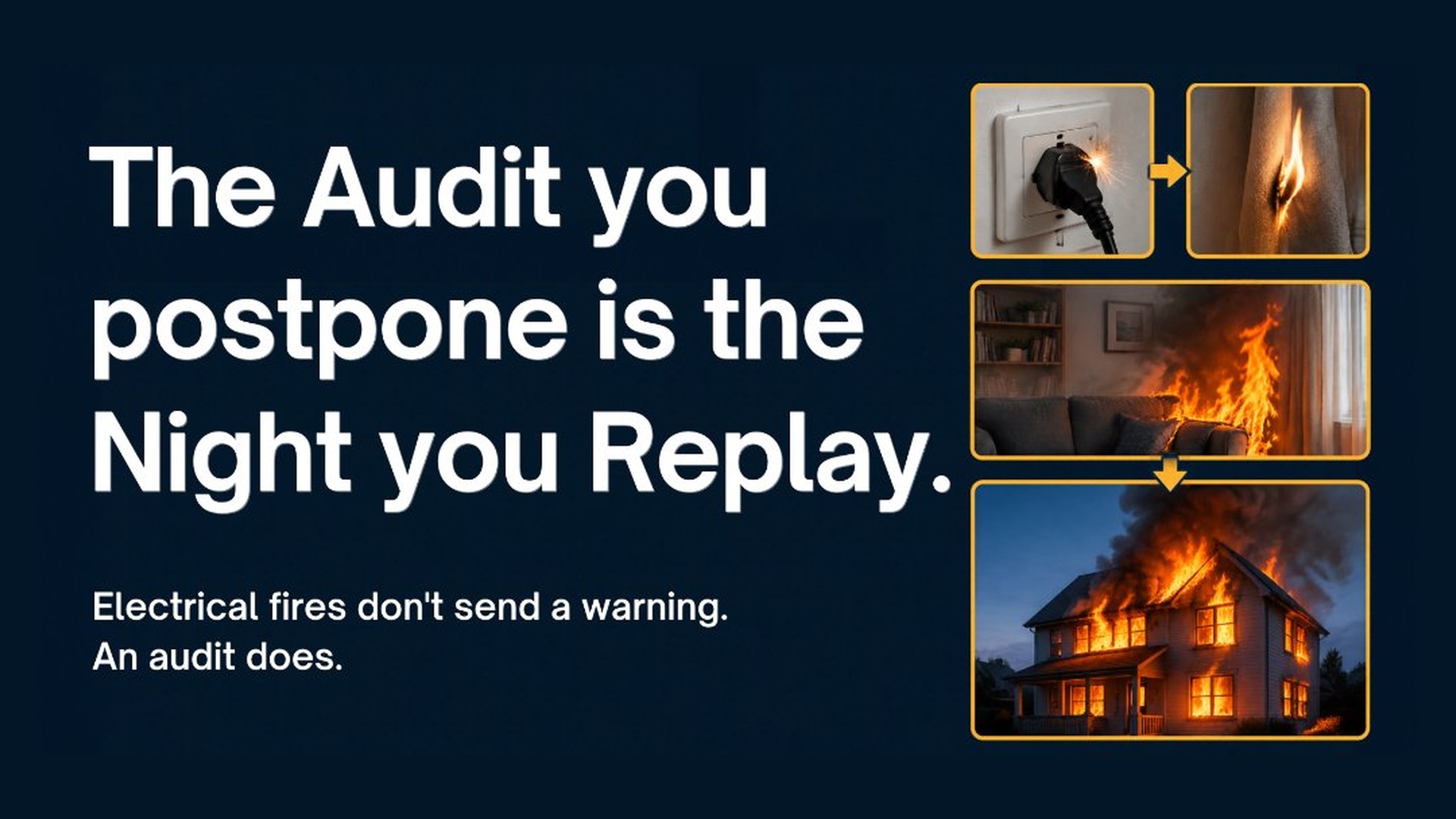
It started with a geyser. It climbed a tower.
On the afternoon of 19 November 2026, a fire tore up the side of a residential high-rise in Hyderabad’s Financial District. Early reports point to a short circuit in a bathroom geyser, one of the most ordinary appliances in an Indian home.
No one was hurt. But the incident is a sharp reminder for every apartment owner, resident welfare association (RWA) and facility manager: electrical fires don’t send a warning. An electrical & fire safety audit does.
What happened at Apartment Complex
A fire broke out in one tower of an apartment complex in the Narsingi–Nanakramguda area on Thursday, 19 November 2026. It was first reported at around 12:04 PM, and four fire tenders were sent to the site (Siasat).
Flames spread across multiple floors of the tower. Residents evacuated, and officials reported no casualties or major property loss (The Pioneer).
The real problem isn’t the geyser
Geysers are designed to be safe. What turns a geyser fault into a building fire is the electrical system around it: the wiring that feeds it, the protection that should cut it off, and the years of negligence regarding electrical & fire safety audits that nobody checks either.
1. Heavy loads on unchecked circuits
A typical 2 kW geyser draws about 9 A at 230 V; a 3 kW unit draws about 13 A. It often runs for 20 to 40 minutes at a stretch, every day. That sustained current heats every weak point in the circuit.
Ageing cables, undersized wiring, loose terminations at the switch or isolator, and corroded connections in damp bathrooms all build up heat silently. Over months, insulation hardens, cracks and eventually fails.
2. Protection that’s never tested
Miniature circuit breakers (MCBs) and residual current devices (RCDs/ELCBs) are the last line of defence. An MCB rated too high for the cable, or an RCD whose trip mechanism has seized, lets a fault keep burning instead of cutting it off in milliseconds.
Most residents never press the RCD test button. Many buildings have never had trip times measured since commissioning.
3. No one looks until it burns
Wiring inside flats usually goes uninspected for years after handover. Owners add ACs, induction cooktops, EV chargers and bigger geysers, but the circuits stay the same. Common-area audits, if they happen at all, rarely extend into individual apartments.
How one flat’s fault becomes a tower’s fire
In a high-rise, a fire rarely stays where it starts. Flats are stacked identically, so the same shafts, ducts and window lines run straight up the building. These are the usual routes fire and smoke take floor to floor:
- Shafts and ducts: Bathroom plumbing ducts and electrical risers run vertically through every floor. Without proper fire-stopping at each slab, they act like chimneys.
- Window-to-window spread: Flames leaving one window can ignite the floor above through its window, balcony or exterior cladding.
- Combustible fit-outs: Curtains, false ceilings, balcony storage and furniture give the fire fuel on each floor it reaches.
- Shared electrical paths: Damaged riser cables or busbars can carry faults beyond the original flat.
We don’t yet know which routes played a part at Pacifica Hillcrest. But the pattern is familiar: a small electrical fault, missed early, becomes a building-wide emergency.
Find the fault before it finds you
An electrical safety audit catches the conditions behind fires like this one, long before smoke appears. A JEF building audit focuses on four critical checks:
| Check | What we do | What it prevents |
|---|---|---|
| 01 Thermal imaging | Scan DBs, isolators, sockets and appliance points with infrared cameras under load | Overheating joints and stressed circuits failing unseen |
| 02 Protection testing | Verify MCB, RCD and ELCB ratings and measure actual trip times | A fault that keeps burning because protection didn’t trip |
| 03 Earthing and bonding | Test earth resistance and continuity for every flat, riser and wet-area appliance | Shock risk and leakage currents in bathrooms and kitchens |
| 04 Load and wiring review | Match cable sizes and circuit ratings to real loads: geysers, ACs, EV chargers | Undersized wiring running hot every day |
The audit ends with a prioritised report: what is critical, what can be scheduled, and what is compliant. Findings are benchmarked against the CEA (Measures relating to Safety and Electric Supply) Regulations, 2023, and relevant Indian Standards for wiring and earthing.
A quick checklist for RWAs, facility managers and residents
You don’t need instruments to spot early warning signs. Use this list now, and call in a professional audit if any answer worries you.
For residents
- Press the RCD/ELCB “Test” button once a month. If it doesn’t trip, get it checked immediately.
- Watch for warm or discoloured switches, buzzing sounds, burning smells or frequent tripping near the geyser.
- Switch the geyser off at the isolator when not needed; don’t leave it on all day.
- Get older geysers (typically 8 to 10 years and above) and their wiring professionally inspected.
For RWAs and facility managers
- Find out when the building last had a full electrical safety audit. If it was never done, or more than a few years ago, schedule one.
- Include individual flats in the audit scope, not only common areas, lifts and pump rooms.
- Check that electrical and plumbing shafts are properly fire-stopped at every single floor slab.
- Keep a record of load additions such as EV chargers and new ACs, and review them against overall circuit capacity.
How JEF helps
JEF Techno Solutions has been making buildings electrically safe for over 30 years, with more than 16,000 audits completed across India and 30+ countries. Our engineers combine thermal imaging, protection testing and earthing measurements with our Digitized AI Powered Tool to turn site findings into a clear, prioritised action plan.
We audit residential towers, gated communities, commercial complexes, hospitals and industrial plants. Every report tells you exactly what to fix first, and why.
Frequently asked questions
- Can a geyser cause a fire?
Yes. Geysers draw high current for long periods, so a short circuit, loose connection or undersized wiring can overheat and ignite nearby materials. Untested MCBs or RCDs can let the fault continue instead of cutting power. - What are the warning signs of a geyser electrical fault?
Warm or discoloured switches, a burning smell, buzzing sounds, sparking, or the breaker tripping repeatedly when the geyser is on. Switch it off at the isolator and have it inspected. - How often should an apartment building have an electrical safety audit?
Most safety practices recommend a full audit periodically, and also after major load additions such as EV chargers, after renovation, or after any electrical incident. Older buildings and those with heavy loads benefit from more frequent checks. - What does thermal imaging find in an electrical audit?
Infrared cameras show hot spots invisible to the eye: loose joints, overloaded cables, failing breakers and stressed appliance points. These are often the earliest signs of a future fire. - Does an RCD or ELCB prevent electrical fires?
An RCD detects leakage current to earth and trips quickly, reducing shock and some fire risks. It must be correctly rated and tested regularly, and it works alongside properly sized MCBs, not instead of them. - Who should arrange an electrical audit in an apartment complex?
Usually the RWA or facility management, covering common areas and, with residents’ consent, individual flats. Residents can also book audits for their own homes.
Don’t wait for a spark to reveal the risk
Electrical fires don’t send a warning. An audit does. Ensure your apartment complex, residents, and assets are safe with a comprehensive audit.
Book an electrical safety audit for your building today at [email protected] →
Think Electrical. Think JEF.


