

NBC & IS RECOMMEND SPD FOR PROTECTION
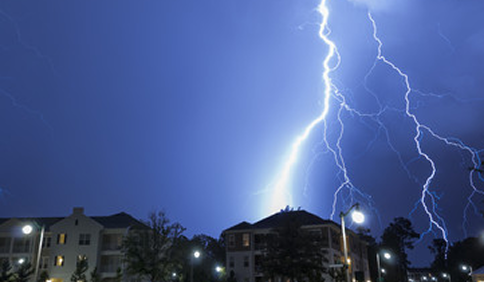
NBC & IS recommend SPD for protection of sensitive electronic equipment from conducted surges through power & data cables. A variety of devices provides over-current protection, but Surge protection devices are the only ones that can safeguard sensitive electronic equipment from overvoltage caused by contaminated power sources and the increasing use of non-linear devices.
Transient over voltages are generated predominantly due to the following reasons:
- Whenever lightning strikes the power or signal cables directly or near the cables.
- As a consequence of faults in the power system.
- Switching on and off of heavy inductive loads etc.
SPD terminology used by different standards bodies:
- Class I, I+II, II, III — terminology used by IEC.
- Type I, I+II, II, III — terminology used by European Norms (EN).
- Class B, B+C, C, D — terminology used by Germans (VDE).
It is wise to use 12.5 kA Iimp rated, Class I+II MOV SPD as per IEC 60364-5-53 for L-N to avoid "follow current" problems associated with Spark gap devices for L-N in 3+1 configuration. It is important to use Spark gap SPD with 50 kA Iimp rating for N-PE because MOV will trip RCDs after getting aged.
SPDs are simple, passive, non-linear components which cannot differentiate between lightning and switching surges. Whether it is spark gap, GDT, MOV or SAD (Silicon Avalanche Diode), they act when the voltage across them exceeds a pre-determined level.
- Class I+II SPDs are recommended at the Main DB of all industries.
- Class II SPDs are recommended at the Sub DB of all industries.
- Class III SPDs are installed near sensitive/critical equipment.
Power line SPDs (which are commonly connected parallel to the load) include a local indication (mechanical flag) as a standard feature and a remote signal (potential free contact) as an optional feature. JEF has a wide range of SPDs to suit all the above requirements.
Please let us know if you need further assistance or have any requirements: [email protected]


