

Wind Turbine Lightning Protection: Why Conventional Protection May Not Be Enough?
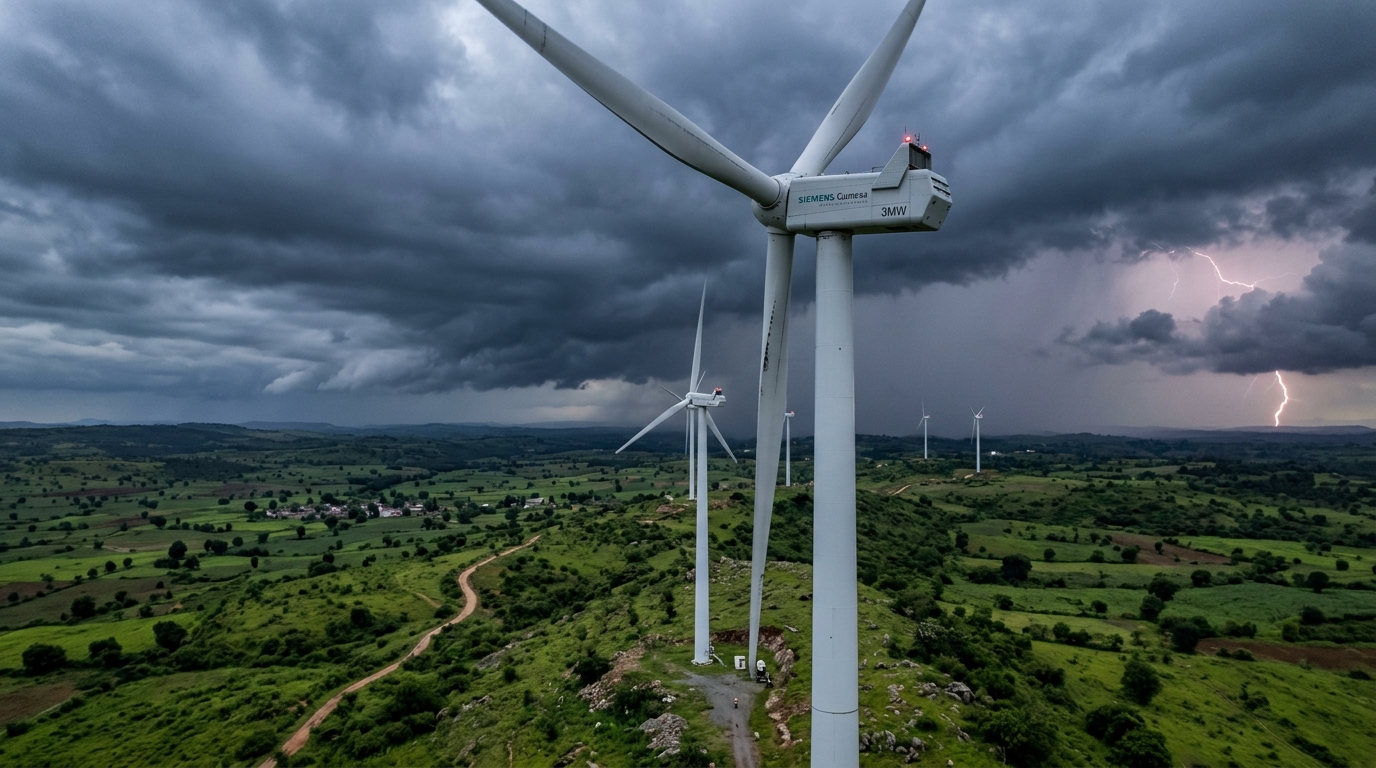
A wind turbine can have a lightning protection system on paper and still lose a blade to the next storm. The reason is simple: a turbine is not a building, and protection designed with building logic leaves gaps exactly where turbines are most exposed.
Picture a 3 MW turbine on a ridge in Gujarat, Karnataka or Tamil Nadu. The tower is bonded. The earth pit tested fine at commissioning. Then a pre-monsoon storm rolls in, and a single strike punctures a blade shell, burns out a pitch controller and trips the converter. The turbine sits idle for weeks while a crane and a replacement blade are arranged.
Nothing was “unprotected”. The protection simply wasn’t designed for how lightning actually behaves around a rotating, 200-metre-class machine.
Why this matters more in 2026 than ever before
India’s wind fleet is growing fast, and every new turbine is taller than the last. Installed wind capacity reached about 59.2 GW by the end of September 2026, led by Gujarat (17,044 MW), Tamil Nadu (12,335 MW) and Karnataka (8,974 MW). FY 2025–26 delivered a record 6.05 GW of new wind capacity, and the government is targeting more than 100 GW by 2030.
Three trends raise the lightning stakes:
- Taller machines attract more strikes: Height is the single biggest driver of strike frequency, and today’s hub heights and rotor diameters put blade tips far above anything else on the landscape.
- Blades take the hits: Almost all direct strikes to a turbine land on the rotor blades, the most expensive and hardest-to-replace component on the machine.
- Insurance is getting stricter: Insurers are tightening cover and excluding predictable lightning damage where the protection system is shown to be ineffective.
The numbers from mature markets are a warning. Industry data attributes over 60% of operational blade losses and around 20% of turbine downtime to lightning. A 2020–2025 insurance study across Sweden, Norway and Finland found blades were the most claimed component, at 40% of claims, with lightning incidents rising over the period.
A wind turbine is not just a tall building
Conventional lightning protection was built around buildings: a fixed structure, an air-termination network on the roof, down conductors on the walls and an earth electrode below. Wind turbines break almost every one of those assumptions:
- It moves: The strike point is a blade that is rotating, pitching and yawing. Research shows blade rotation can itself trigger lightning and noticeably increase strike counts.
- It makes its own lightning: Very tall structures don’t just receive downward strikes. They launch upward leaders that start upward lightning, which often carries a long-duration current and a high charge.
- Its strike path crosses moving parts: Current has to travel from blade to hub to nacelle to tower, across pitch bearings, the main shaft and the yaw bearing. Without a deliberate path, it arcs through bearings and gears.
- Its “roof” is non-conductive: Blades are mostly glass- or carbon-fibre composite. A strike that misses the receptor can puncture, delaminate or split the shell.
- Its brain sits in the strike zone: Pitch controllers, converters, sensors and SCADA electronics sit in the nacelle and hub, metres from where lightning current flows.
- It is never alone: A wind farm is dozens of turbines linked by kilometres of buried cable and a shared substation. A surge at one turbine can travel to the others.
Where conventional protection falls short
The problem is rarely missing hardware. It is building-style thinking applied to a machine that behaves very differently. Here is where the gaps usually open up:
| Area | Building-style approach | What a wind turbine actually needs |
|---|---|---|
| Risk assessment | Generic structure inputs under IEC 62305-2 | Turbine-specific risk under IEC 61400-24, including height, terrain, upward lightning and site flash density; LPL I by default unless a risk analysis justifies lower |
| Strike interception | Rods or mesh on a fixed roof | Blade tip and side receptors, verified by test, so strikes attach where intended and not on internal conductors |
| Current path | Straight down conductors to earth | A controlled path across the pitch bearing, main shaft and yaw bearing, using brushes or spark gaps so current doesn’t arc through bearings |
| Surge protection | Type 1/2 SPDs at the main board | SPDs coordinated across lightning protection zones in hub, nacelle and tower base, on power, control, sensor and data lines |
| Earthing | A single earth pit tested once | A foundation earth electrode bonded into a farm-wide earthing network, verified for resistance and potential rise under surge |
| Maintenance | Periodic visual check | Blade receptor and down-conductor continuity tests, plus post-strike inspection triggered by lightning detection data |
The blade is the clearest example. Studies show that even protected blades can launch leaders from the internal down conductor instead of the receptor, at several points along its length. When that happens, the strike punches through the shell rather than attaching to the receptor. Receptors also erode with every strike, so a system that worked in year one can underperform by year five.
What a turbine-specific approach looks like
The right answer is a complete lightning protection system designed around the turbine, using IEC 61400-24 (the dedicated wind turbine standard, current edition 2019 with its 2024 amendment) alongside IEC 62305 for the general framework.
- Start with a proper risk assessment: Map site flash density, terrain, turbine height and the cost of downtime. This decides the protection level for each sub-system, not just the structure as a whole.
- Divide the turbine into lightning protection zones: Treat the blades, hub, nacelle, tower and base as zones, and protect every cable that crosses from one zone to the next.
- Engineer the current path through moving parts: Bridge pitch and yaw bearings and the main shaft so lightning current bypasses bearings and gearboxes.
- Coordinate surge protection end to end: Install SPDs matched to each zone boundary on power, control, sensor, SCADA and communication lines, including the aircraft warning light.
- Design earthing at farm level: Bond each foundation electrode into the collector-cable earthing network and the substation, and verify step and touch potentials.
- Inspect, test and learn: Test receptor and down-conductor continuity on schedule, correlate strike data with turbine faults, and run root cause analysis after every unexplained failure.
One principle ties it together: lightning protection is not stopping strikes. It is giving the lightning current one controlled path to earth, and keeping its energy out of everything else on the way.
7 signs your wind farm needs a lightning protection review
If any of these sound familiar, your protection may be working on paper but not in the field:
- Unexplained trips after storms: Converter, pitch or SCADA faults that cluster around lightning activity.
- Repeat blade repairs: Punctures, tip damage or delamination on the same turbines, season after season.
- Bearing or gearbox pitting: Electrical arcing marks found during maintenance with no clear cause.
- No recent continuity test: Blade receptor and down-conductor resistance hasn’t been measured since commissioning.
- Earthing never re-verified: Foundation and farm earthing were tested once, before years of soil drying and corrosion.
- Older or repowered turbines: Machines designed to earlier editions of IEC 61400-24, or towers fitted with taller rotors.
- An insurer asking questions: A claim queried or a renewal that asks for evidence of lightning protection adequacy.
Catching damage early pays off. Operators who stop a turbine while blade damage is still repairable can cut repair costs by 75% or more, compared with running it until the damage spreads.
How JEF helps wind asset owners
For over 30 years, JEF has helped 10,000+ customers in 30+ countries manage lightning, earthing and surge risk, with 16,000+ digitized reports delivered. For wind and solar plants, that experience comes together in one team:
- Lightning Protection Adequacy Audit: Site survey, lightning risk assessment and a gap analysis of your existing LPS, with corrective recommendations, BOQ and drawings.
- Earthing Health Assessment: Measurement and verification of foundation and farm-wide earthing, so lightning current actually has somewhere safe to go.
- Surge Protective Devices and LPZ design: Coordinated Type 1, 2 and 3 protection across power, signal, data and DC lines.
- Lightning protection components: A coordinated range type-tested at 200 kA on the 10/350 µs waveform, twice the 100 kA required by IEC 62561.
- Renewable power system studies: Steady-state, dynamic, EMT and harmonic studies using PSCAD, EMTP-RV, DIgSILENT, PSS®E, ETAP and CDEGS.
- Root Cause Analysis: Forensic investigation of post-storm failures, so the same fault doesn’t return next season.
Whether you are commissioning a new wind farm, repowering an old one or chasing a recurring fault, the starting point is the same: measure the real risk, then close the real gaps.
Frequently Asked Questions
- Which standard covers lightning protection for wind turbines?
IEC 61400-24 is the dedicated standard for wind turbine lightning protection. It works alongside the IEC 62305 series, which sets the general framework for risk assessment, protection measures and surge protection. - Why are wind turbine blades struck so often?
Blade tips are the highest point on the turbine and often on the whole landscape. Almost all direct strikes land on the blades, and rotation can increase the number of strikes a turbine receives. - Can a standard building lightning protection system protect a wind turbine?
Not on its own. A turbine needs blade receptors, a controlled current path across rotating bearings, zone-based surge protection and farm-level earthing, none of which a building-style design covers. - What protection level do wind turbines need?
IEC 61400-24 recommends Lightning Protection Level I, the highest, for all turbine sub-systems unless a risk analysis shows a lower level is enough. - How often should a wind turbine lightning protection system be inspected?
Follow the turbine manufacturer’s schedule and the standard, and add an inspection after any confirmed strike. Blade receptor and down-conductor continuity tests are central, as receptors wear with every strike. - Do surge protective devices matter if the turbine already has receptors?
Yes. Receptors handle the direct strike, but induced and conducted surges still reach the nacelle, hub and tower-base electronics. Coordinated SPDs at every zone boundary protect them.
Don’t wait for the next storm to find the gap
Lightning season returns every year. The only question is whether your turbines meet it with a system designed for wind, or one designed for a building.
Talk to JEF’s lightning protection team about an LPS adequacy audit for your wind farm →
Think Electrical. Think JEF.


