

PQ SERVICES - ECONOMIC BENEFITS OF POWER FACTOR AND HARMONIC STUDIES

The harmonic frequency in a power system is the positive integer multiple of the fundamental frequency. Power factor (PF) refers to the ratio of working power in watts (KW) to perceived power in kilovolt amperes (KVA).
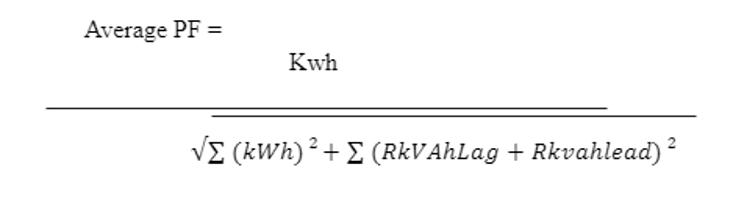
Many Power utilities in India are billing their industrial and commercial consumers based on Active Energy Consumption (Kwh) along with fixed charges. In Maharashtra state, the consumers are charged based on kVAh consumption combining kWAh & kVArh. The prime objective of kVAh based billing is to encourage the consumers to maintain near unity power factor to achieve energy loss reduction, improve system stability, PQ services, and voltage profile.
The average wattage losses in a typical industrial facility can be 15-20% of total demanded power. These wattage losses can be reduced by improving the power factor closer to unity and reducing the voltage and current harmonic distortion below 5%.
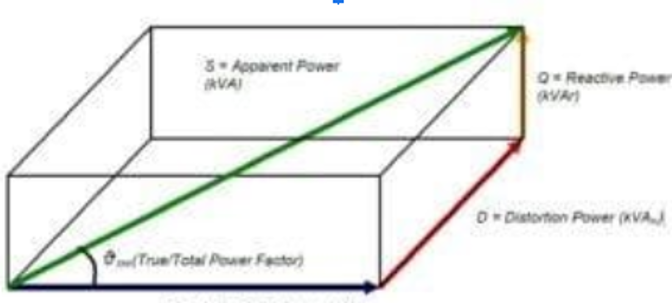
True/Total PF = Displacement PF × Distortion Factor. The distortion power factor is contributed by harmonics in the network and reduction in harmonic levels can improve the total power factor to reduce the overall Energy cost.
Hysteresis Losses
Hysteresis loss is caused by magnetization and demagnetization of the core as current flows in forward and reverse directions. The energy to accomplish the realignment of the magnetic domains comes from the input power and is not transferred to the secondary winding — it is therefore a loss and results in heat.
Typical hysteresis losses as a percentage of Power Demand: 1% – 2%
Eddy-Current Losses
Eddy current losses are the result of Faraday's law. The induced EMF causes a circulating current called an Eddy current, proportional to the square of frequency. Eddy current losses occur in circuit breakers, lighting ballasts, transformers, motor starters, motor windings, and building wiring near steel/iron structures.
Typical eddy current losses as a percentage of Power demand: 2% to 3%
Skin Effect Losses
When AC current is applied to a conductor, the current concentrates near the surface of the conductor. Harmonic loading increases skin effect losses by the square of the increase in frequency above nominal line frequency.
Typical skin effect losses as a percentage of Power demand: 2% to 4%
Proximity Effect Losses
Proximity effect is caused by the mutual influence of multiple current carrying conductors. Their interaction causes uneven current distribution in the conductors, increasing the losses.
Typical proximity effect losses as a percentage of Power demand: 2% to 3%
Transformer Losses
A non-linear load on a transformer leads to harmonic power losses causing increased operational costs and additional heating. It leads to higher losses, early fatigue of insulation, premature failure and reduction of the useful life of the transformer.
Typical transformer losses as a percentage of Power Demand: 2% to 5%
Line Losses
In addition to I²R losses and dielectric losses, cables have other losses such as skin-effect and proximity-effect developed by magnetic induction. The harmonic currents can further increase the apparent AC resistance significantly above nominal DC resistance values.
Typical line losses as a percentage of Power Demand: 1% to 3%
The Power Quality experts at JEF Techno Solutions have extensive experience and knowledge of all the factors impacting the operating efficiencies of each of these components. Our Power Quality service team are equipped with state-of-the-art test and analysis equipment to conduct site evaluation of electrical system losses.
Please let us know if you need further assistance or have any requirements: [email protected]


